JC Smale: brick texturing machine for an OEM
Automation developed alongside the mechanical design, with a recipe-based HMI and commissioning at the OEM workshop and the end-customer brickworks.
Metromotion Controls automates kilns, dryers, material handling and machines for brick, tile, paver and heavy clay manufacturers, and writes the controls for OEM machine builders who supply the industry.
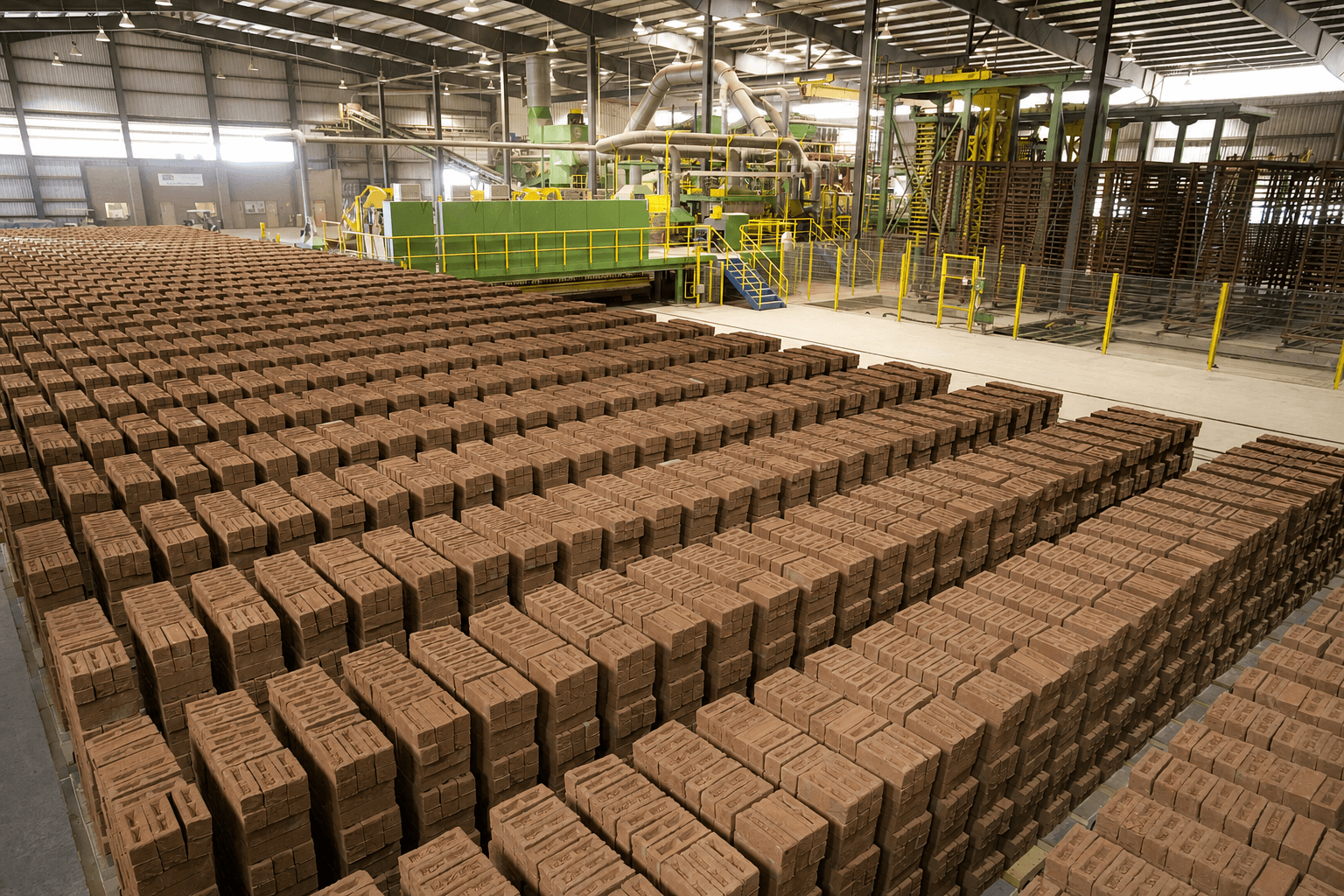
Metromotion Controls has worked on both sides of the building products industry. For JC Smale, an OEM machine builder, the team automated a brick texturing machine while its mechanical design was still evolving, built a recipe-based HMI and supported commissioning in the workshop and at the end-customer brickworks. For Austral Bricks at Wollert, the team delivered a certificate-secured MQTT connectivity and condition monitoring reference implementation.
Kilns and dryers are long thermal processes where a control fault shows up hours later as cracked, bloated or off-colour product. The control work sits in the temperature and pressure profiles, burner and combustion control, fan and damper duty, and the car and setting movements that feed them. OEM machine builders need something different again: controls that can be configured for each customer site rather than rewritten, tested in the workshop before shipping and commissioned at the end-customer plant.
Temperature, pressure and airflow have to follow the firing and drying curves across long cycles. Loops tuned years ago, or held in manual, let the profile drift and the defect only appears when the product comes out.
Older PLCs and operator panels make fault isolation slow, spares are hard to source and the programming software often runs on a single ageing laptop.
OEM builders often develop the mechanical design and the controls at the same time, so the PLC code and HMI have to follow a moving design and still be ready for the customer's site.
Kilns, dryers and heavy material handling place high demands on drives, instrumentation and control panels, and on the data connections that monitor them.
We program continuous thermal plant from the P&ID and a short conversation rather than a long functional specification, then document the control philosophy as we build it. For kilns and dryers that means stabilising the loops that govern product quality: temperature and pressure profiles along the kiln, combustion and burner control, fan and damper duty, and the transfer sequences that move green and fired product without blockage or damage.
For OEM machine builders, PLC code and HMIs are structured so one machine design can be configured for each customer rather than rewritten. Recipes hold the product parameters, the HMI is built around how operators set up and run the machine, and the logic is tested in the builder's workshop before shipping. For JC Smale, that approach let the controls keep pace with a brick texturing machine whose mechanical design was still changing, with commissioning support at the workshop and the end-customer site.
Legacy kiln and machine controls are migrated in stages, with existing logic reviewed and carried across rather than guessed at, I/O verified against the field and commissioning planned with fallback paths so production risk stays controlled.
Production, utility and condition data is collected from kilns, dryers and high-duty equipment so energy use, downtime and wear are visible. At Austral Bricks, a certificate-secured MQTT implementation gave the site a validated reference for broader condition monitoring rollout.
Automation developed alongside the mechanical design, with a recipe-based HMI and commissioning at the OEM workshop and the end-customer brickworks.
Certificate-secured MQTT data collection at the Wollert brick plant, documented as a reference implementation for broader rollout.
Legacy boiler programs migrated onto a current platform and verified through I/O testing, giving an OEM a consistent baseline for repeat deployment.
Upgrade of legacy control hardware and operator interfaces with improved loop control, process visibility and alarm management.
Kilns, dryers and OEM machines need control platforms that suit continuous operation, demanding environments and repeat deployment.
Rockwell and Siemens PLC and SCADA for continuous thermal plant and material handling.
Rockwell CompactLogix and FactoryTalk View ME for OEM machine controls and recipe-based HMIs.
Integration of drives, burners, instrumentation, weigh systems and packaging assets.
MQTT and historian connectivity for condition monitoring and utility data.
Yes. For JC Smale, Metromotion Controls automated a brick texturing machine during its mechanical development, built the recipe-based HMI and supported commissioning at the workshop and the end-customer brickworks. For Steamtech, a boiler OEM, the team migrated legacy boiler programs onto a current platform for repeat deployment.
Yes. Most kiln and dryer upgrades replace the control hardware, operator interface and loop control while the kiln, burners and fans stay in service. The work is staged around production so the plant keeps firing.
Yes. We support ongoing optimisation, fault response and lifecycle upgrades after handover, for plant owners and for OEMs supporting machines at their customers' sites.
Both. Metromotion Controls has spent years working alongside process companies, which is why we can program a plant from the P&ID and a walkthrough rather than a long functional specification. In building products that shows in kiln and dryer thermal control, combustion and fan duty, and material handling sequencing.
Melbourne automation contractor capability for scoped control-system projects from design through commissioning.
PLC logic, SCADA architecture, HMI upgrades, fault finding and historian integration for production sites.
Modernise legacy PLC, SCADA, HMI and control infrastructure with staged cutover planning.
OEE, reports, quality, CIP, maintenance and energy data from the team that builds and programs the lines.
OEM machine automation with recipe-based HMI design and workshop and on-site commissioning.
Certificate-secured MQTT connectivity for condition monitoring at a brickworks, delivered as a documented reference implementation.
How availability, performance and quality are actually calculated, and why source-of-truth machine data matters.
Live OEE, line status and stop reasons read directly from the PLCs on food and beverage lines.
Plant events that raise CMMS work orders, condition alerts before a stop, and runtime counts for preventive maintenance.
Process control for chemical, process and utility plants: loops, sequences, batch, boilers, steam and utilities.
Legacy boiler PLC programs migrated to CompactLogix for an OEM, verified through I/O testing and commissioned at end-customer sites.
Upgrading SLC 500 and PLC-5 systems to CompactLogix and ControlLogix: routes, code conversion, HMIs and the Bulla churn case study.
Condition monitoring to ISO 17359 and ISO 13374, the P-F curve, MQTT and OPC UA data acquisition, and how condition data ties into OEE.
Tell us the site change, upgrade or support requirement. We'll review the scope, timing and technical constraints and respond with a clear next step.