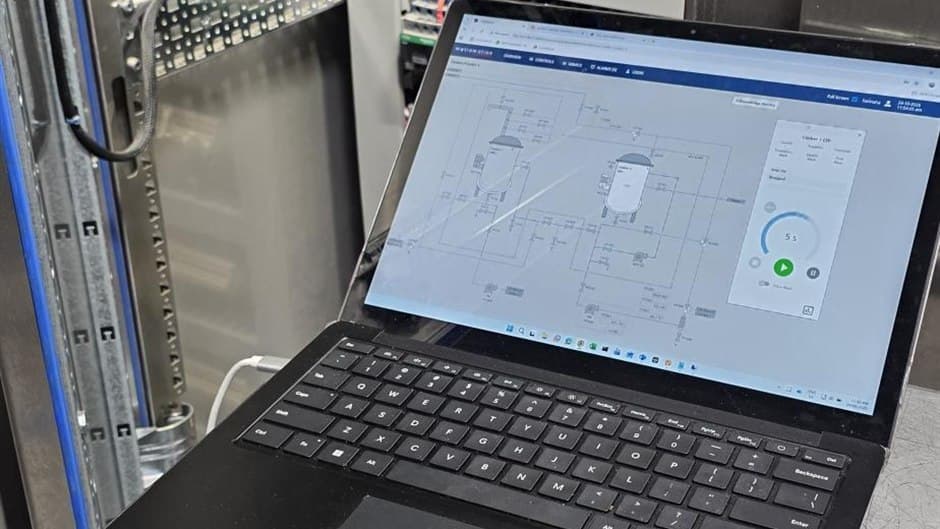
Fitting sensors and collecting data is the easy part of condition monitoring. What determines whether a programme pays for itself is selecting the right assets, sampling at the rate the failure mode demands, moving the data into a system that can act on it, and building alerts the maintenance team trusts. Metromotion Controls builds condition-monitoring and production-data systems for manufacturers across Australia, and this guide treats the work as an engineering discipline rather than a sensor-buying exercise.
This post supports our industrial data and IIoT service, where condition-monitoring data is read from the asset, moved over standard protocols and stored in a historian rather than collected in isolation.
Condition monitoring as a defined discipline
Two standards frame the work. ISO 17359 is the umbrella standard for condition monitoring and diagnostics of machines. It sets out the procedure: identify the critical assets through a reliability and criticality audit, select the measurement parameters that reveal the failure modes that matter, establish the measurement method and collection interval, set alarm criteria, then act on the diagnosis. It points to supporting standards for specific techniques such as vibration and thermography.
ISO 13374 covers the data-processing and presentation side. It breaks a condition-monitoring system into functional blocks: data acquisition, data manipulation, state detection, health assessment, prognostics and advisory generation. The value of that model is architectural. Raw measurement is only the first block, and the steps that turn a vibration reading into a maintenance action have to be designed, not assumed. A programme that collects data but never implements state detection or health assessment will not produce the warning it was bought for.
The ISO 18436 series covers the competence and certification of the people, including vibration analysts. It matters because interpreting a spectrum is a skilled task, and a programme is only as good as the analysis applied to its data.
Reactive, preventive and predictive maintenance
Condition monitoring exists to support a maintenance strategy, so be clear about which strategy each asset sits under.
- Reactive (run-to-fail). The asset runs until it fails. Correct for cheap, non-critical, redundant or easily stocked items; monitoring here adds cost without changing the decision.
- Preventive (time or cycle based). Components are serviced on a fixed schedule regardless of measured condition. Suited to assets with a known wear-out pattern, but it can replace healthy parts early and still miss a fault that develops between services.
- Predictive (condition based). Intervention is triggered by measured condition, such as a rising vibration trend. It targets effort at the asset that actually needs it, and condition monitoring is the data layer that makes it possible.
Most sites run all three at once. The engineering judgement is matching each asset to a strategy by consequence of failure, not applying predictive monitoring everywhere the technology allows.
The P-F curve sets the sampling rate
The case for predictive maintenance rests on the P-F curve. Point P is where a potential failure first becomes detectable by a chosen technique; point F is functional failure, where the asset can no longer perform its function. The interval between them is the warning window the technique can give.
That interval depends on the failure mode and the detection technique together. An early rolling-element bearing defect can show in high-frequency vibration weeks before failure, then become audible, then show as a temperature rise. Vibration detects it early and gives a long P-F interval; temperature detects it late and gives a short one.
The interval sets the sampling rate. The working rule is to sample at no more than half the P-F interval, so at least two readings fall inside the warning window before functional failure. If vibration gives a six-week interval, a three-weekly reading is defensible and a continuous online sensor is unnecessary. If the interval is hours, only continuous monitoring will catch it. Setting a sampling rate without estimating the P-F interval is the most common reason a programme collects data yet still misses the failure it was meant to warn about.
Sensing: vibration, temperature and motor current
The measurement parameters in ISO 17359 come from a small set of techniques that cover most rotating-equipment faults.
| Sensor type | What it detects | Typical assets | Relative P-F warning |
|---|
| Vibration (accelerometer) | Bearing wear, imbalance, misalignment, looseness | Motors, pumps, fans, gearboxes | Early |
| Temperature (RTD / thermocouple / infrared) | Overheating, cooling failure, friction, lubrication loss | Motors, drives, bearings, compressors | Mid to late |
| Motor current signature (MCSA) | Broken rotor bars, load change, mechanical drag, phase loss | Motors, motor-driven pumps and fans | Mid |
| Acoustic emission | Early-stage bearing defects, cavitation, leaks | Pumps, compressors, valves | Early |
| Oil analysis / particle count | Gear and bearing wear debris, contamination | Gearboxes, hydraulic systems | Mid |
Vibration is the workhorse for rotating equipment because it gives the earliest warning of the most common faults. An accelerometer on a bearing housing can be trended as an overall velocity level in millimetres per second, or analysed as a spectrum, where defect frequencies such as the bearing's outer-race and inner-race pass frequencies identify which component is degrading. Temperature is cheap and intuitive but detects most faults later in the P-F curve, which makes it a confirming parameter rather than the primary early warning. Motor current signature analysis infers mechanical and electrical condition from the current the motor already draws, useful where mounting a sensor on the machine is difficult.
More sensors do not mean better outcomes. Choose the parameter that detects the failure mode as early as the P-F interval requires, and add confirming parameters only where they change the diagnosis.
The data path: edge acquisition, MQTT Sparkplug B and OPC UA
An edge device close to the asset samples the sensor and does the first ISO 13374 blocks locally: it computes an overall level and a spectrum, applies report-by-exception so it transmits only when a value moves, and buffers data through network drops. From the edge, two protocols carry the data.
- MQTT is a lightweight publish and subscribe protocol designed for constrained and intermittent networks. Devices publish to topics on a broker and consumers subscribe to what they need, so adding sensors means adding publishers without rebuilding the integration layer. Sparkplug B, an Eclipse Foundation specification, adds the structure plain MQTT lacks: a defined topic namespace, a typed payload, and birth and death certificates so the system always knows whether a device is online. SCADA platforms with MQTT modules consume Sparkplug B payloads directly.
- OPC UA is a strongly typed, secure machine-to-machine protocol that carries rich information models, well suited to the structured link between controllers, SCADA and the historian.
A sound pattern uses Sparkplug B for the distributed edge sensors reporting by exception and OPC UA between the PLC, SCADA and historian layer, with both landing in the same historian. This integration belongs in the industrial data and IIoT and OT networks layers, where the network is designed to carry production and condition data without contention.
Historian integration and the link to OEE
A historian records each tag with its value and timestamp at the moment it changed, which is what lets an analyst look back over weeks of vibration trend or pull the temperature record around a stoppage. A platform such as Ignition can consume Sparkplug B and OPC UA directly, store the tags, and present trends, thresholds and maintenance reports from one place; building those alarms and screens to suit the maintenance workflow is part of the PLC, SCADA and HMI layer.
The connection to OEE is direct. Condition monitoring reduces the frequency of unplanned stops by giving warning before a failure forces one, which protects availability. When a stop does happen, the condition record gives a timestamped, machine-sourced reason tied to a specific asset, which makes the downtime classification more defensible than a reason recalled at shift end. The limits of OEE as a metric are covered in our guide on where OEE misleads.
A worked example: a bearing vibration alerting scheme
The figures below are illustrative, and any real scheme must be set against the asset's own baseline. Consider a 75 kW process pump motor on a food and beverage line, with an accelerometer on the drive-end bearing housing reporting overall vibration velocity in mm/s RMS. The general reference for evaluating that level is ISO 10816, now largely superseded by the ISO 20816 series.
| Band | Example velocity (mm/s RMS) | Interpretation | Action |
|---|
| Baseline | up to 2.8 | Normal running, established over the first weeks | Trend only |
| Alert | 2.8 to 4.5 | Condition has changed from baseline | Schedule inspection at next opportunity |
| Alarm | 4.5 to 7.1 | Significant degradation | Plan intervention within the P-F window |
| Trip / urgent | above 7.1 | Approaching functional failure | Stop and inspect before further damage |
Two refinements make the scheme defensible rather than a set of fixed numbers. First, the baseline comes from the asset itself: a motor that normally runs at 1.8 mm/s and climbs to 3.2 mm/s has changed even though it is still inside a generic acceptable band, so a sustained rise of more than about 50 percent from baseline should alert before any absolute threshold is crossed. Second, alerts should require consecutive exceedances, or a short sustained period on a continuous sensor, so a single transient does not erode the maintenance team's trust. The sampling rate follows the P-F interval: an estimated six-week interval supports a two-to-three-weekly reading, and an asset critical enough for a continuous online sensor uses the same banding with automatic alerts.
The Australian context
Australian programmes run on the same international standards, with ISO 17359, ISO 13374 and the ISO 10816 / ISO 20816 vibration series available through Standards Australia as adopted standards. Two local factors shape the work.
The first is criticality driven by supply. Many Australian sites sit weeks from a replacement motor, gearbox or large bearing, which lengthens the consequence of an unplanned failure and pushes major rotating assets higher in the criticality ranking than they would sit in a market with same-day supply. That alone can justify monitoring assets that elsewhere would run to failure.
The second is the framework around the installation work. Fitting sensors, edge devices and cabling on operating plant falls under the general duties of the model WHS laws administered through Safe Work Australia, alongside the relevant electrical wiring rules. Where condition data crosses onto the OT network, the connectivity should follow Australian Cyber Security Centre guidance on protecting operational technology, so adding sensors does not widen the control system's attack surface. That dimension is covered in our guide on OT network security for manufacturing.
Common mistakes to avoid
- Monitoring everything because the technology allows it. Sensors on low-consequence assets generate alerts nobody acts on. Rank assets by consequence of failure and monitor where early warning changes the decision.
- Setting the sampling rate by convenience. A monthly reading on a failure mode with a one-week P-F interval will reliably miss the failure.
- Using absolute thresholds without a baseline. Each asset has its own normal signature. Watch for change from baseline as well as a fixed number being crossed.
- Stopping at data collection. Under ISO 13374, acquisition is only the first block. A programme that stores trends but never converts them into an assessment and an advisory is unfinished.
- Treating it as a software purchase. The value sits in the engineering: choosing parameters, setting thresholds against the asset, and integrating multi-vendor sensors and controllers cleanly.
- Building alerts the team will not act on. An alert with no clear owner, no defined action and a history of false positives gets ignored. Define who responds and what they do.
What this means
The value of condition monitoring is the maintenance action it enables, not the volume of data collected. Frame the programme with ISO 17359 and ISO 13374, match each asset to a strategy by consequence of failure, set the sampling rate from the P-F interval, sense the parameter that detects the failure mode early enough, move the data over Sparkplug B or OPC UA into a historian, and alert against the asset's own baseline. A narrow deployment on the right assets will outperform a broad one nobody reviews, and the same data sharpens the OEE picture rather than sitting in a separate system.
References