Skip to content
Process Control · JUNE 2026 · 13 min read

Beverage Process Automation in Australia: Carbonation, Blending and Filling Control

Key points

Key points
1

Quality on a beverage line is held by a few measured loops

Blend ratio, brix, carbonation level and fill volume are the variables a consumer notices. Each one is a control loop with a measured variable, a setpoint and an interlock, and the line is only as consistent as those loops.

2

Pasteurisation is a food-safety control point, not a heating step

Flash and tunnel pasteurisation hold a time and temperature that the PLC enforces with a forward-flow and divert interlock, and the SCADA layer keeps the evidence that the dose was met on every unit of product.

3

Stage automation against where variability and cost actually sit

Blending and carbonation usually return first because they set product quality and ingredient cost. Pasteurisation interlocks come next as a food-safety control, then filling and CIP for throughput and changeover.

Beverage process automation is the use of a control system to run a beverage line as a connected process: blending syrup and water to a brix specification, carbonating to a target CO2 level, holding a pasteurisation dose where the product needs it, and filling and capping containers at rate, with the loops, interlocks and records that keep every unit within specification. Metromotion Controls is a control systems integrator based in Mount Waverley that delivers beverage process automation across Melbourne, Victoria and Australia for soft drink, juice, water, ready-to-drink and fermented beverage producers.

A beverage line looks like a series of machines, but the quality the consumer notices comes down to a handful of measured loops: the blend ratio that sets sweetness and flavour, the carbonation level that sets mouthfeel, the pasteurisation dose that keeps the product safe, and the fill volume that keeps every container right. Each is a control problem with a measured variable, a setpoint and an interlock. This guide works through them in process order, from the syrup room to the filler, with a worked carbonation example and criteria for staging the work.

This post supports our PLC, SCADA and HMI programming service, where beverage blending, carbonation, pasteurisation interlocks, filling control and CIP logic are written and tuned. It connects to the broader process work we do across food and beverage.

The syrup room: blending and brix control

The syrup room is where the product is defined. Syrup, the concentrated mix of sugar, acid, flavour and colour, is blended with treated water to a ratio that sets the finished product's brix and flavour. Hold that ratio accurately and the product is consistent; let it drift and every downstream step works on an out-of-spec base.

Brix is the measure of dissolved solids, expressed in degrees brix, and the practical proxy for sugar content and the syrup-to-water ratio. The control system holds the blend to target brix in one of two ways.

Inline blending

Syrup and water are metered continuously to a fixed ratio as product flows on, trimmed against an inline brix or density measurement. It suits continuous, higher-volume production and uses little tank space, but demands fast, tight flow control on both streams.

Batch blending

A full batch is mixed in a tank, checked against a refractometer, and released once in specification. It suits smaller runs, frequent recipe changes and products that need a hold or hydration step, putting the control weight on tank sequencing and verification before release.

Ratio control with brix trim

Both methods run a ratio loop, syrup flow held as a proportion of water flow, with an outer trim loop that nudges the ratio on the measured brix. The ratio loop holds the bulk of the accuracy; the trim corrects for syrup-strength and instrument variation.

Degassing and deaeration

Dissolved air interferes with carbonation and fill performance, so many lines deaerate the water before blending. The control system sequences the vacuum or membrane deaeration step and confirms it before product is sent to carbonation.

The flow loops that meter syrup and water are fast and carry pump and turbulence noise, so they run as PI loops rather than full PID, the reasoning set out in our guide to PID loop tuning. The brix trim loop sits on top and runs slowly, because the measured brix lags the ratio change.

Why ratio accuracy is worth the effort

Sugar is one of the largest ingredient costs on a sweetened beverage line, so blending consistently to the lower edge of the brix specification rather than the centre reduces sugar giveaway across a run. Blending tightly also cuts off-spec product at changeover, when a loose ratio loop produces a slug of out-of-spec product while it settles, and the same logic applies to acid and flavour dosing.

Carbonation control

Carbonation is the dissolution of carbon dioxide into the beverage, and it is one of the more temperature-sensitive loops on the line. The amount of CO2 that dissolves at a given pressure rises sharply as the liquid gets colder, reflecting the temperature dependence of gas solubility, which falls as temperature rises. A carbonation system therefore chills the product first, then doses CO2 against a pressure and flow setpoint to reach a target level, usually expressed in volumes of CO2 or grams per litre.

The control challenge is that two variables move the result. The CO2 dose sets the gas added; the product temperature sets how much of it stays in solution. If temperature drifts as the chiller load changes through a run, the carbonation level drifts with it unless the control system holds temperature tightly or compensates the CO2 setpoint for it. On lines where temperature cannot be held perfectly, temperature-compensated carbonation control is the difference between a stable product and one that varies through the shift.

A worked carbonation loop, illustrative only

The following figures are illustrative, chosen to show the structure of the loop rather than measured on any installation. Suppose a carbonator targets 3.5 volumes of CO2 in a cola at 4 degrees Celsius.

  • Measured variables: product flow, product temperature after the chiller, carbonator pressure, and CO2 mass flow or the inferred carbonation level.
  • Primary loop: CO2 is dosed against carbonator pressure and product flow to hold the target volumes, the dose scaled to flow so the level holds as throughput changes.
  • Temperature compensation: the CO2 setpoint is corrected for measured product temperature, so if the product warms from 4 to 6 degrees the controller raises pressure to keep dissolved volumes on target.
  • Interlocks: carbonation is inhibited if product flow stops, if temperature rises above the limit where the target cannot be held, or if CO2 supply pressure falls below the minimum needed to dose, so under-carbonated product cannot be filled unnoticed.

The loop is not exotic, but it treats temperature as part of the control problem rather than assuming the chiller holds product temperature steady.

Thermal processing: flash and tunnel pasteurisation

Pasteurisation delivers a defined thermal dose, a temperature held for a minimum time, that reduces spoilage organisms and pathogens to a safe level, and on beverage lines it takes two main forms. Flash or high-temperature short-time (HTST) pasteurisation heats the product through a plate or tubular heat exchanger, holds it in a hold tube for the required residence time, then cools it, all before filling. Tunnel pasteurisation heats the already-filled and sealed container through heated water sprays, which suits products pasteurised in the bottle or can.

Pasteurisation is a food-safety control point, and the defining element of the control logic is the forward-flow and divert interlock.

Pasteurisation control: what the PLC enforces

  • Product is only allowed forward to filling while the measured hold temperature is at or above setpoint, so under-processed product cannot reach the filler.
  • Any drop below the hold setpoint diverts the flow back to the balance tank, and the divert valve is proven in its diverted position by feedback, not by command alone.
  • Flow rate through the hold tube is held to the value that gives the required residence time, because the dose is a temperature held for a time and the time depends on flow.
  • Start-up runs in divert until the system is up to temperature, going to forward flow only once the hold condition is proven.
  • The SCADA layer records hold temperature, flow and every divert event per batch, so evidence that the dose was met exists for each unit of product.

The interlock and divert logic live in the PLC because they are a protective control with a direct food-safety consequence, and the same separation applies that we set out for pasteurisation in our Ignition SCADA guide: the control and interlock execute in the PLC, while SCADA provides operator visibility and the historised evidence. Where the diversion is part of a wider safety case, the trip is assessed as a safety function in its own right. The flow loop that holds residence time is tuned slow and stable, and the temperature loop on the heating medium is a classic slow thermal loop that justifies full PID with anti-windup.

Filling: fill control, counter-pressure and changeover

Filling is where fill accuracy and container handling meet. The fill volume in every container is a control loop, and consistency across the filler keeps the line off the underfill and overfill limits.

Two fill methods are common. Volumetric filling measures the volume delivered with a flow meter on each valve, holding a consistent volume regardless of container shape variation. Level or fill-height filling stops the fill when product reaches a sensed height, giving a consistent visual level for clear containers. Either way each valve is a small loop, and the control system trends fill performance per valve so a drifting or blocked valve is found before it produces a run of under-fills.

Counter-pressure filling for carbonated product

Carbonated product cannot be filled into an open container without losing its carbonation, because the dissolved CO2 comes out of solution as the product hits atmospheric pressure, which foams and makes fill height inconsistent. Counter-pressure filling pressurises the container with CO2 to roughly the product pressure before the liquid is admitted, so it fills against an equal pressure and the CO2 stays in solution. The control system sequences each valve through pressurisation, fill, settling and snift, with bowl pressure coordinated to the carbonator.

The monoblock and changeover

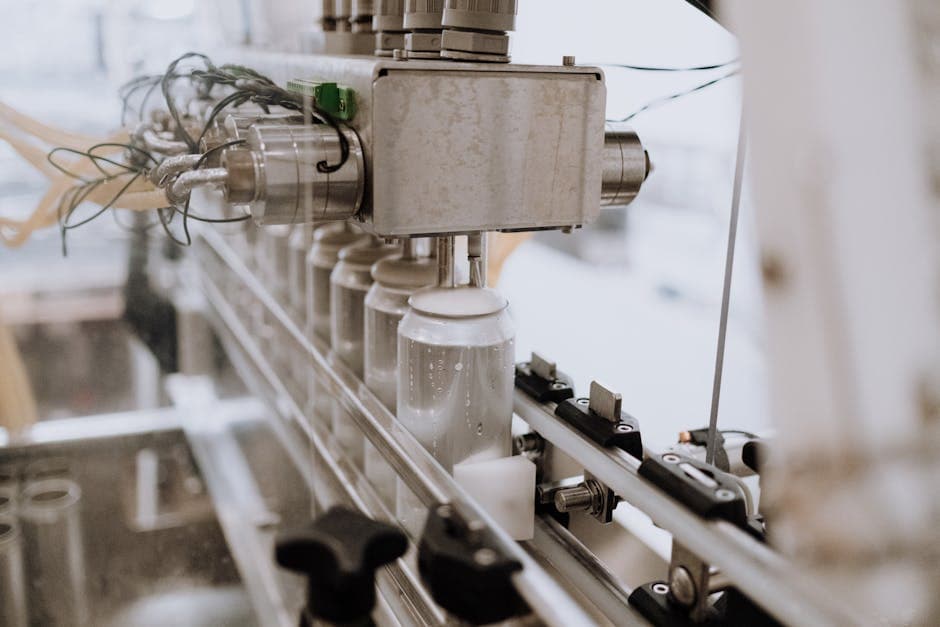
Many beverage lines run a rinser-filler-capper monoblock, where rinsing, filling and capping sit on one synchronised frame and drive so containers move through the three operations without separate transfers. From a controls view the monoblock is one coordinated motion and sequencing problem, usually handled with a PackML state model so the line and any MES layer can read a consistent state and mode structure. Changeover between container formats then becomes a coordinated recipe change rather than a manual reset of three machines, which cuts stopped time and removes the error of setting one machine and forgetting another.

Water treatment and product transfer

Treated water is an ingredient, often the largest by volume, so the control system sequences and monitors the water treatment train, filtration, carbon, reverse osmosis or other steps depending on the source water, and confirms it meets specification before blending and deaeration. The transfer pumps that move product between stages also matter, because abrupt starts and stops on a full hygienic line generate pressure surges that damage seals and instruments. Ramping drives and profiling valve closures to avoid water hammer, covered in our guide to pump control and water hammer, keeps the line gentle on those fittings.

CIP and hygienic design

A beverage line is cleaned in place between products and on a hygiene schedule, and the CIP system runs through the same control layer as production, sequencing pre-rinse, caustic wash, intermediate rinse, acid wash and final rinse through the process circuits. Our guide to CIP automation sets out where that investment returns: phases that end on conductivity and temperature rather than timers, coverage verification on every branch, and the records an auditor relies on.

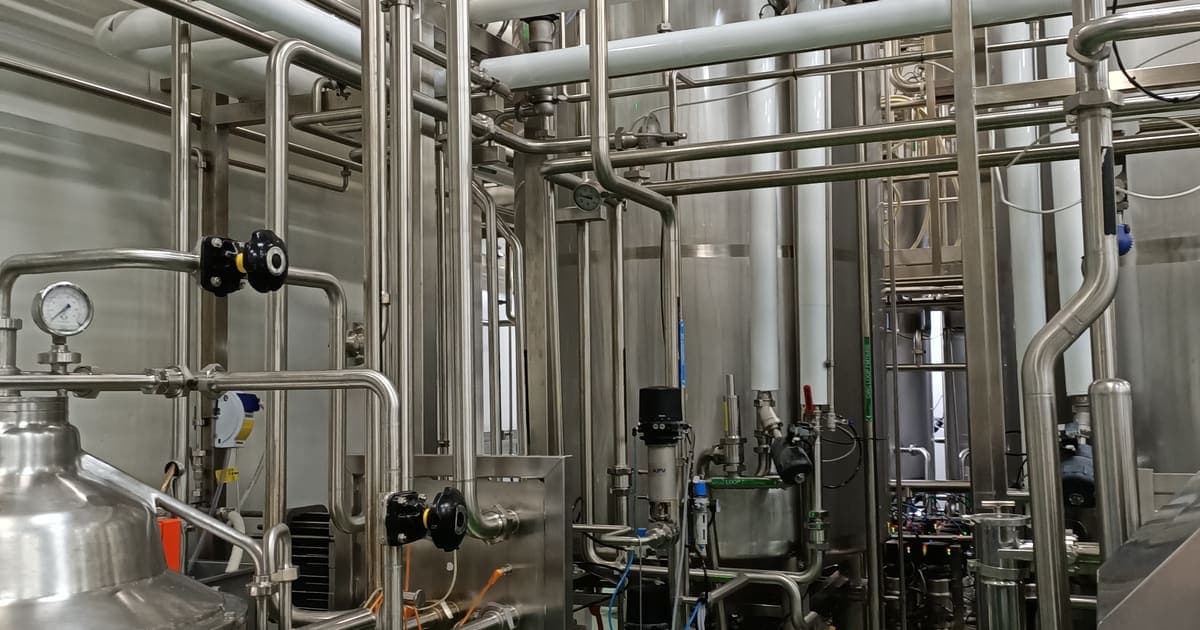
Hygienic design and control have to be considered together. Clean-in-place only works on a circuit that can actually be cleaned, which means designing out dead legs and uncleanable geometry in the first place. Standards such as the 3-A Sanitary Standards exist to keep those geometries out of the design, and a control engineer should flag any leg that flow cannot scour, because instrumentation can detect an unclean branch but cannot clean one.

Traceability and OEE

Two streams of data come off a well-instrumented beverage line. Traceability links each batch to its blend, carbonation, pasteurisation record where applicable, and the treated water and ingredients that went into it, which supports the fast, defensible isolation of affected product expected under the FSANZ Food Standards Code when a complaint or recall has to be investigated.

Overall equipment effectiveness, read from validated machine states rather than operator estimates, shows where the line actually loses time: short stops, changeover duration, CIP windows and the small losses that never reach a shift report. Where this data flows up to an MES layer, the production record and the quality record become one record, the connected-data thinking we cover in MES and SCADA integration. The same plant-floor data thinking underpinned our Remedy Drinks MEX CMMS and Ignition integration, which raises maintenance work orders automatically from plant events rather than manual entry.

Decision criteria: how to stage beverage automation

A beverage producer rarely automates everything at once, and the right order depends on where variability and cost sit.

Where to start, and why

  • Start with blending and carbonation where product consistency or ingredient cost is the pain. These loops set quality directly and reduce sugar and CO2 giveaway, so they usually return first.
  • Prioritise pasteurisation interlocks where the product needs a thermal process, since this is a food-safety control staged on risk rather than payback.
  • Tackle filling next where underfill giveaway, changeover time or fill rejects are the constraint, since per-valve fill control and recipe-driven changeover are where throughput gains sit.
  • Bring CIP into scope where trade waste, chemical cost or audit fragility is the issue, since the gains compound on a line that cleans frequently.
  • Add traceability and OEE once the process loops are stable, because the data is only as good as the control underneath it.

The thread through the criteria is that automation should follow the measured constraint, not a fixed template, and a staged assessment establishes which constraint dominates before any commitment.

Where beverage automation makes the difference

The quality a brand depends on lives in a few loops, and the line is only as consistent as those loops are tuned and the interlocks enforced. Pasteurisation in particular is a food-safety control point that belongs in the PLC with SCADA evidence behind it, not a heating step left to run open.

For Australian beverage producers weighing where to invest, the practical path is to find where the line actually loses consistency, quality or time, stage the work against that, and build the data layer once the process underneath is stable. If you can share your line layout, product range and where the variability shows up, we can work through where automation returns first.

References

The standards, definitions and process figures referenced above are general industry and standards sources, cited so the technical claims can be checked against the originals. They are not Metromotion Controls measurements.

About the author

Tommy Kim writes for Metromotion Controls, a Melbourne control systems integrator delivering PLC, SCADA, controls integration and commissioning for food, beverage, dairy and FMCG manufacturers across Australia.

Common questions
What is brix and how is it controlled on a beverage line?

Brix is the measure of dissolved solids in a solution, expressed as degrees brix, where one degree brix is approximately one gram of sucrose per hundred grams of solution. On a beverage line it is the practical proxy for sugar content and, in a blended product, for the syrup-to-water ratio. It is controlled either by inline blending, where syrup and water flows are metered to a fixed ratio and trimmed against an inline brix or density measurement, or by batch blending in a mixing tank checked against a refractometer before release. The control system holds the ratio and trims it on the brix reading so the finished product sits within its specification band.

How does carbonation control work and why does temperature matter so much?

Carbonation is the dissolution of carbon dioxide into the beverage, and the amount that dissolves at a given pressure depends strongly on temperature. Cold liquid holds far more CO2 than warm liquid at the same pressure, because gas solubility falls as temperature rises. A carbonation system therefore chills the product, then doses CO2 against a pressure and flow setpoint to reach a target carbonation level, usually expressed in volumes of CO2 or in grams per litre. Because solubility moves with temperature, the control system has to hold product temperature steady or compensate the CO2 setpoint for it, otherwise the carbonation level drifts as the chiller load changes.

Why is pasteurisation treated as a food-safety control point in the PLC?

Pasteurisation delivers a defined thermal dose, a temperature held for a minimum time, that reduces spoilage organisms and pathogens to a safe level. If product passes through under temperature, the dose is not met and that product is not safe to fill. The PLC enforces this with a forward-flow and divert interlock: product is only allowed forward to filling while the measured hold temperature is at or above setpoint, and any drop diverts the flow back to the balance tank automatically. This is a control function with a direct food-safety consequence, so it sits in the PLC with the interlock, and the SCADA layer records the temperature and divert events as evidence the dose was met.

What is the difference between inline blending and batch blending?

Inline blending meters syrup and water continuously to a set ratio as the product flows to the next stage, trimming the ratio against an inline brix or density measurement. It suits continuous, higher-volume lines and uses less tank space because there is no hold step. Batch blending mixes a full batch of syrup and water in a tank, checks it against a refractometer, and releases it once it is in specification. It suits smaller runs, frequent recipe changes and products that need a hold or hydration step. The control work is similar in principle, ratio and brix, but inline blending demands faster, tighter flow control while batch blending puts more weight on tank sequencing and verification before release.

What is counter-pressure filling and why do carbonated drinks need it?

Counter-pressure filling pressurises the container with CO2 to roughly the pressure of the carbonated product before the liquid is admitted, so the product fills against an equal pressure rather than into atmosphere. Without it the pressure drop as carbonated product enters an open container releases dissolved CO2, which foams, slows the fill, makes fill height inconsistent and loses carbonation. By equalising the pressure first, counter-pressure filling keeps the CO2 in solution during the fill, which is why it is standard for carbonated soft drinks, sparkling water and carbonated ready-to-drink products.

How is fill height or fill volume held consistent across a filler?

Consistent fill is held either by volumetric filling, where a flow meter on each valve measures the volume delivered, or by level or fill-height filling, where the fill stops when product reaches a sensed height in the container. Volumetric filling gives a consistent volume regardless of container variation and is common on modern electronic fillers. Level filling gives a consistent visual fill height, which matters for clear containers where the consumer sees the level. Each valve is a small control loop, and the control system also trends fill performance per valve so a drifting or blocked valve is found before it produces a run of under-fills.

What is a rinser-filler-capper monoblock?

A monoblock combines the rinser, filler and capper into a single synchronised machine on one frame and one drive system, so containers pass from rinsing to filling to capping without separate transfers. The advantage is that the three operations stay in time with each other and there are fewer points where containers are handled or can jam. From a controls point of view the monoblock is one coordinated motion and sequencing problem, often handled with a PackML state model, rather than three machines that have to be interlocked across conveyors. Changeover between container formats is also managed as a single coordinated recipe on the monoblock.

Where does beverage automation usually pay back first?

Blending and carbonation usually return first, because they set product quality and ingredient cost directly: tighter brix and carbonation control reduces giveaway on sugar and CO2 and cuts off-spec product at changeover. Pasteurisation interlocks come next where the product needs them, because they are a food-safety control with audit value rather than a throughput gain. Filling and CIP improvements follow for throughput, changeover time and trade-waste cost. The right order for a given site depends on where its variability and cost actually sit, which is what a staged assessment establishes before any work is committed.

Share:LinkedInX
Next step

Planning work in Process Control?

Map out scope, delivery approach and what to have ready before the first conversation. Answer a few questions and Metromotion Controls returns a tailored scoping brief on screen.