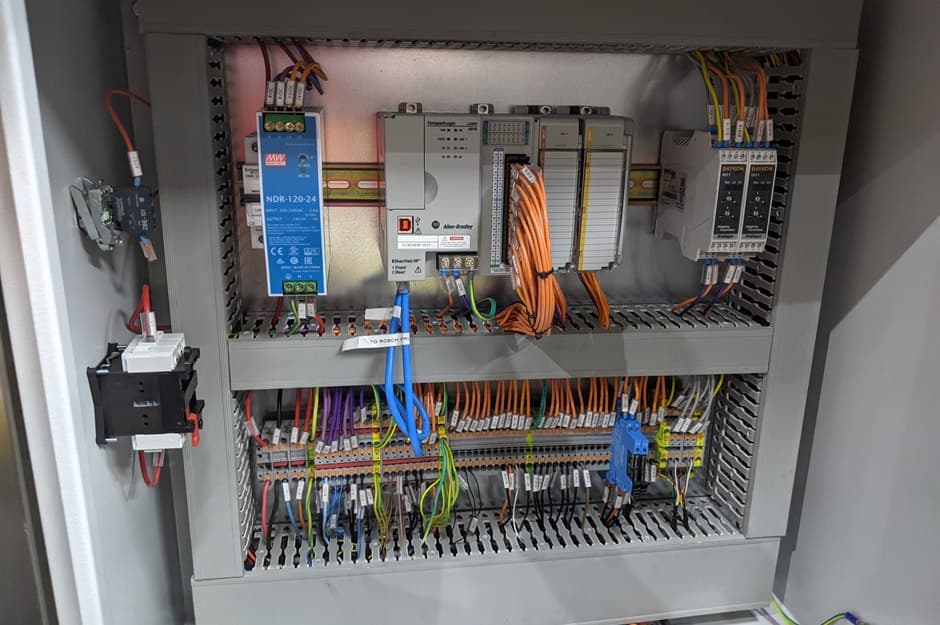
Siemens SIMATIC is one of the most widely installed automation platforms on Australian process plants, and the engineering for it now runs almost entirely through TIA Portal. This guide is written from the perspective of an integrator that programs and commissions Siemens controllers on local food, beverage and dairy sites. Metromotion Controls delivers Siemens automation projects from Mount Waverley for manufacturers across Melbourne, Victoria and Australia, which gives a practical view of where Siemens is the right platform and where the real decisions sit on a brownfield site.
This post supports our PLC, SCADA and HMI programming service, where Siemens STEP 7 and WinCC delivery, PROFINET and PROFIsafe design, and migration of legacy S7 and S5 plant all sit.
The first thing to get straight on a Siemens project is which controller family the work targets, because the platform is broad and includes ranges still in service but out of production.
SIMATIC S7-1500
The current performance controller for plant-scale process control, larger I/O counts, motion and demanding scan times. It is the usual base for a new food or beverage process line with sequencing, batching and safety, and the platform the Siemens engineering model is built around.
SIMATIC S7-1200
The current compact controller for smaller machines, standalone skids and modest I/O. It shares the TIA Portal engineering model with the S7-1500, so code structure and skills carry across between the two.
S7-300 and S7-400 (legacy)
The previous generation, still running on many Australian sites. Siemens announced the S7-300 and ET 200M phase-out in October 2023 and ended standard deliveries on 1 October 2025, with spares and repair support running for roughly a decade beyond that. The S7-400 remains in service on process plants, but the engineering direction is the S7-1500.
ET 200 distributed I/O
The SIMATIC distributed I/O family that puts I/O in the field, the MCC or at the machine, connected back over PROFINET or PROFIBUS. ET 200SP and ET 200MP are the current ranges and are how most S7-1500 systems reach their field signals.
The practical point is to confirm what is actually on site and what the OEM machines arriving are built on. A plant can easily run a current S7-1500 process controller alongside legacy S7-300 line equipment and packaged machines on S7-1200, all under one engineering environment, and naming the current and legacy parts of the estate is the start of any sensible upgrade plan.
TIA Portal as the unified engineering environment
Siemens engineering has consolidated around TIA Portal because it puts the whole automation stack in one project rather than across several disconnected tools. The Totally Integrated Automation Portal holds the controller programming, the visualisation, the drives and the network configuration together, so the parts that have to agree with each other share the same data.
The main tools inside the environment are:
- STEP 7 for programming the S7 controllers, including the program structure, data blocks, network configuration and hardware setup.
- WinCC for configuring the HMI panels and the SCADA layer, drawing on the same tag definitions the controller uses.
- Startdrive for commissioning and parameterising SINAMICS drives in the same project as the logic that commands them.
- STEP 7 Safety for configuring the fail-safe program where Safety Integrated is in scope.
What this buys a team is fewer handoffs. Where the PLC, HMI and drives are configured in separate applications, every tag, alarm and parameter crosses a tool boundary, and each boundary is a place for the systems to drift out of step. In TIA Portal a controller tag referenced on an HMI screen is the same object, an alarm defined once is available to the visualisation, and a drive parameter is visible to the program that uses it. The shared project is where the integration time is saved, the discipline behind our PLC programming in Melbourne.
The programming model: IEC 61131-3, SCL and GRAPH
Siemens implements IEC 61131-3, the international standard that defines the programming languages for programmable controllers, so the concepts carry across from any other compliant platform. The skill is choosing the right representation for each task.
- Ladder (LAD) and Function Block Diagram (FBD) suit discrete interlocks, permissives and the graphical logic maintenance staff read on a running machine.
- SCL (Structured Control Language) is the Siemens structured-text language, close to Pascal, and the right home for sequencing, loops, recipe and scaling maths, string handling and conditional branching. It is compact and reviews well under version control because it is text.
- GRAPH is the Siemens sequencer, an SFC-style language that describes a process as steps and transitions. It is the natural tool for a defined sequence such as a CIP cycle, a batch or a machine startup, because the active step is visible and the structure matches how the process runs.
The vendor-independent body PLCopen publishes guidance on writing portable, maintainable code against the standard at plcopen.org, worth knowing whichever platform you build on.
Structured code with the optimised block model
The structure of a Siemens program decides whether a site can maintain it. Build it around function blocks with instance data blocks, so a pump, a valve group, a tank or a heat exchanger becomes a reusable block that owns its own logic, state and interlocks and exposes a clean interface. Keep the sequence logic separate from the device blocks, so the recipe can change without rewriting how a valve behaves. Tie tag naming to the P&ID and instrument loop numbers, so a tag on the drawing maps to a tag in the controller. This is the same discipline that turns a P&ID into control logic on any platform, and on the S7-1500 and S7-1200 it fits the optimised data block model, where symbolic access is the default and a block can be extended without shifting every downstream address.
Simulation and virtual commissioning with PLCSIM
Proving a program against a simulator before site moves the bulk of the debugging off the critical path. PLCSIM runs a simulated S7 CPU on the engineering PC, so the logic and the WinCC HMI can be exercised without controller hardware. PLCSIM Advanced extends this to a virtual controller that an external process simulation model can drive, supporting virtual commissioning against a model of the plant behaviour. Sequences, interlocks, alarms, mode changes and fault handling are driven through the simulator so defects surface where they are cheap to fix, rather than on a live line under startup pressure.
WinCC: matching the visualisation tier to the system
The WinCC family inside TIA Portal spans operator panel through to plant SCADA, and choosing the right tier early avoids a rebuild later. WinCC is configured in the same project as the controller, so the tags and alarms defined once are shared with it.
- WinCC Comfort and WinCC Advanced target operator panels and single-station HMI, suiting a machine or line with a local operator interface.
- WinCC Professional is the SCADA-class option inside TIA Portal for larger supervisory systems with more clients and a plant-wide scope.
- WinCC Unified is the newer web-based visualisation system built on open web technologies, for both machine-level and plant-level applications.
The right tier follows the number of clients, the architecture and whether browser-based access matters. A single packaged machine usually needs a Comfort or Advanced panel; a plant-wide supervisory system points toward Professional or Unified. The trade-offs mirror the wider question in our SCADA platform comparison. Siemens is progressively positioning WinCC Unified as the successor to the classic tiers, so check where the family stands before committing a new project.
Networks and safety: PROFINET, PROFIBUS and Safety Integrated
A Siemens system is built on its network as much as its controller, and on most current designs that network is PROFINET, the Ethernet-based industrial network connecting the controller to distributed I/O, drives and field devices. Older installations often run PROFIBUS, the earlier fieldbus, and a brownfield design frequently has to bridge both during a staged upgrade.
Safety runs on the same physical network through PROFIsafe, the safety communication profile that carries safety-related signals over a standard PROFINET or PROFIBUS network without compromising the safety function. This is what Siemens calls Safety Integrated: a fail-safe controller, an F-CPU, executes the safety program and communicates with fail-safe I/O over PROFIsafe, alongside standard control traffic on the same wires.
Safety functions belong in the F-CPU, separate from the standard control program. An emergency stop, a guard interlock or a safe-state trip runs there with its own assessed integrity level and does not depend on the standard logic or the SCADA layer; WinCC provides the operator visibility, alarm annunciation and historised record, but it does not execute the protective action. Whether a fail-safe controller is required, and to what integrity level, is an output of the machine risk assessment rather than a default.
A worked example: an S7-1500 pasteuriser skid
The following is deliberately simple and illustrative, not a real project. Consider an HTST pasteuriser skid controlled by an S7-1500: a transfer pump (P-101), a plate heat exchanger, a product-outlet temperature loop (TIC-201) holding the pasteurisation temperature, a hold tube with a flow transmitter (FT-301), and a flow diversion valve (FDV-401). The safety-related function is the divert: if product leaving the hold tube is below the legal pasteurisation temperature, the valve must move it to divert rather than send it forward.
The control program is built in TIA Portal as follows.
- Device blocks in STEP 7 for the pump, valves and the temperature loop (a PID), each a function block with its own instance data, interlocks and clean interface.
- A GRAPH sequence for startup, run and shutdown: prove permissives, establish flow through the regeneration section, bring the heating up, prove the hold-tube temperature, then allow forward flow, with defined behaviour on hold or abort.
- SCL for the scaling, recipe values and calculation logic.
- The safety divert in the F-CPU. The temperature element the safety function trusts, the diversion logic and the fail-safe command to FDV-401 sit in the fail-safe program over PROFIsafe, independent of the standard sequence, which only annunciates the state.
- WinCC provides the operator screens, alarm list and historised record evidencing the process ran within specification.
The point is the separation. The GRAPH sequence commands the device blocks and reads their feedback, the device blocks know how to run a pump or valve safely, and the safety divert lives in the F-CPU where its integrity is assessed independently. That structure lets the FAT against PLCSIM test the sequence and devices on their own, and lets a technician trace why the skid is holding without the original programmer on the phone.
Decision criteria: when Siemens is the right fit
Most Australian sites are already committed to a platform on at least part of the plant, and the right answer is usually lifecycle fit rather than abstract preference. The broader trade-offs are covered in our PLC platform comparison.
When Siemens is the right platform for the site
- The installed base is already Siemens, so spares, support agreements and maintenance familiarity sit on one platform and switching rarely pays for itself.
- The OEM machines arriving are built on Siemens, common for European process and packaging equipment, so a Siemens line controller integrates with the fleet most cleanly.
- The in-house electrical and maintenance team already reads STEP 7 and WinCC, so the site can support the system without depending on a single external party.
- The project needs tight integration of PLC, HMI, drives and safety in one engineering environment, which is what TIA Portal is built to provide.
- Australian distribution, spares lead time and support coverage for the chosen range have been confirmed as current.
Rockwell is often the better fit where the site is already FactoryTalk and Logix throughout, the maintenance team and integrator network are Rockwell-skilled, and the existing code library and spares sit on that platform. Neither vendor is better in the abstract; the right call follows what is installed, what the machine fleet runs and what the site can support.
Migrating S5 and S7-300 to S7-1500
The usual trigger for a Siemens migration is spares and recovery, not performance. The S5 family is long discontinued, and S7-300 with ET 200M passed its delivery end in October 2025, so a line running either today is on a defined clock, with spares cost and lead time climbing toward the end of support. The right time to plan is when one card failure would turn into a sourcing problem, the same trigger we set out for any legacy PLC migration.
The work is more than swapping hardware. The program moves into the current TIA Portal model, re-expressing older addressing and pointer constructs, including ANY pointer parameters that become VARIANT, and moving toward the optimised block model. The HMI is rebuilt in the current WinCC tier, and the network usually moves from PROFIBUS toward PROFINET, often bridging both during a staged cutover. A converter handles structure and the engineer handles correctness, proven through factory and then site acceptance testing. Our automation upgrades work covers staged migration that keeps a live plant running, line by line where it cannot stop at once.
Siemens on Australian food, beverage and dairy sites
On a dairy or food and beverage site the control program has to respect cleaning modes and CIP interaction as part of the logic, and the divert and trip functions that protect product safety are assessed separately from basic process control. Getting the structure right in TIA Portal, modular device blocks, GRAPH sequences, safety in the F-CPU and the right WinCC tier proven against PLCSIM before site, decides how the line starts and how easily it is supported.