1
Recipe and batch structure carry the high-changeover load
Pet food plants run many SKUs across shared equipment. An ISA-88 recipe layer turns each new formulation into parameters against a tested phase library rather than fresh PLC code.
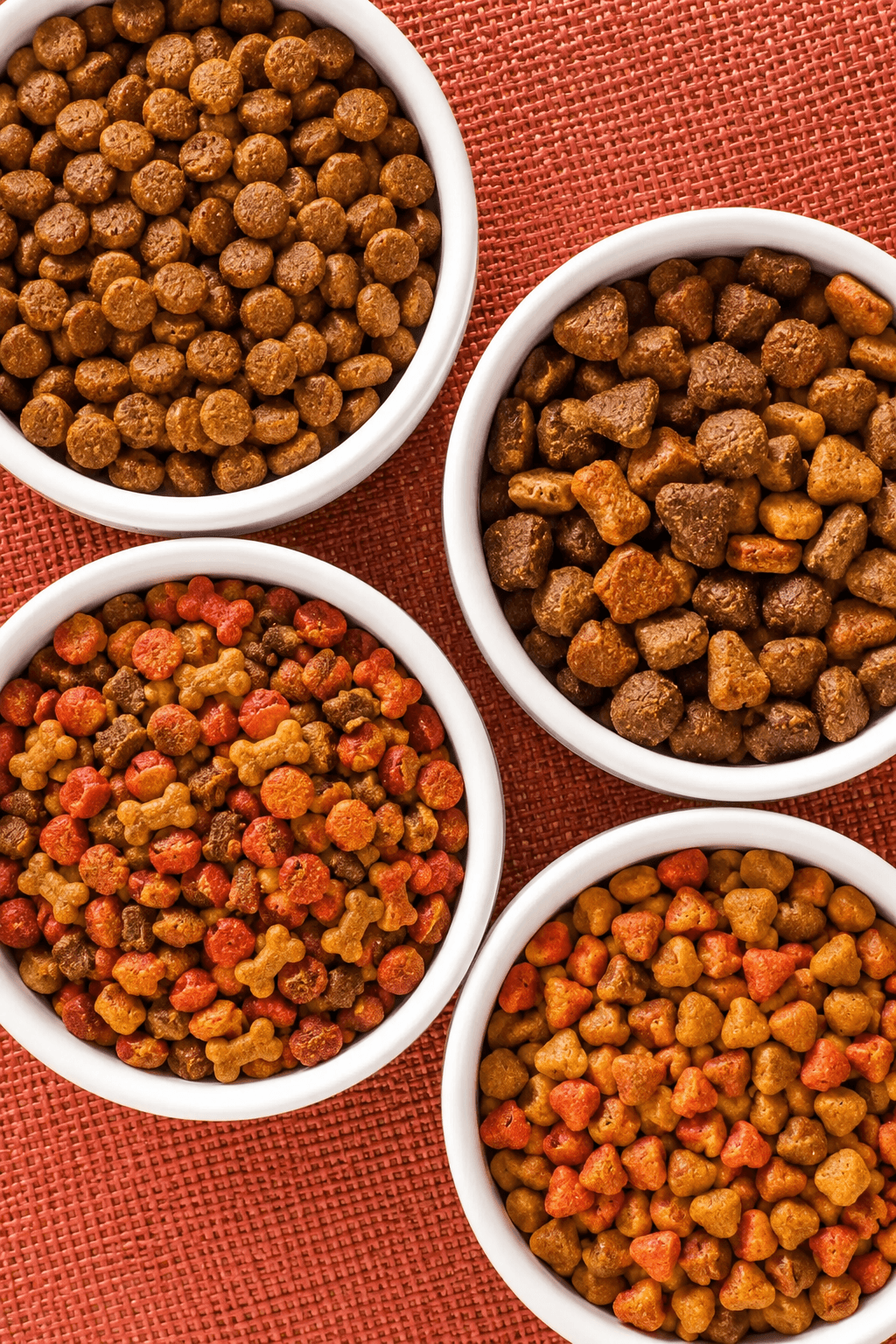
Pet food plants run many SKUs across shared equipment. An ISA-88 recipe layer turns each new formulation into parameters against a tested phase library rather than fresh PLC code.
Kibble extrusion and raw-material rendering both depend on coordinated control of temperature, moisture, screw speed and pressure. The control loops and interlocks decide product consistency and yield more than any single setpoint.
Metal detection, X-ray and process critical control points need to be interlocked and recorded. Genealogy from raw-material receival through to finished pallet is what narrows a recall to the affected lots.
Pet food manufacturing places a specific set of demands on a control system: many products on shared equipment, continuous thermal processes that have to hold product consistency across long runs, raw-material streams that need careful handling, and traceability that has to stand up if a lot is ever questioned. Metromotion Controls is a control systems integrator based in Mount Waverley that delivers automation across Melbourne, Victoria and Australia for pet food, food and beverage processing plants. This guide sets out where the control design matters most on a pet food line, from raw-material receival through to a traceable finished pallet.
This post supports our PLC, SCADA and HMI programming service, where recipe and batch control, extrusion and dryer control, CCP interlocking and line traceability are delivered. It connects to our pet food industry work.
A pet food plant is several distinct processes sharing a site, and each shapes the control design differently.
Made by extrusion. Dry ingredients are ground and blended, preconditioned with steam and water, cooked and shaped through an extruder die, then dried, coated and packed. This is the highest-volume stream on most plants and the most control-intensive.
Blended, filled into cans or pouches, seamed or sealed, then retorted. The retort cook is a thermal process with a defined time and temperature that governs commercial sterility and shelf stability.
Raw animal material is cooked to separate fat and protein, producing tallow and meal that feed back into formulations. A continuous thermal and separation process with its own cooker, vapour and separation control.
Baked, formed and semi-moist treats: lower volume and higher changeover, which puts the emphasis on recipe flexibility rather than continuous throughput.
These streams share material handling, packaging and the traceability layer, so the control architecture has to span them even when each process is engineered on its own terms.
Pet food plants live with high SKU counts and frequent changeover. A mid-sized plant can run dozens of formulations across the same grinding, blending and extrusion equipment, with recipes that change as ingredient availability and cost move. Hard-coding each recipe into the PLC does not scale; every new variant becomes a software change.
ISA-88 is the structure that makes this manageable. It separates batch manufacturing into a physical model, what equipment exists, a procedural model, what the plant does, and a recipe model, what parameters and product apply. The full treatment of the standard sits in our guide to batch control and ISA-88 for food manufacturing; the point here is what it does for a high-changeover pet food plant.
The procedural model gives the plant a phase library that belongs to the equipment, not to any one product. A blending unit has phases such as dose to weight, agitate, recirculate and discharge, written and tested once. A recipe is then a set of parameters against that library: which ingredients, what target weights, what agitation time and what discharge route. A chicken-and-rice formulation and a lamb formulation run on the same equipment using the same phases and differ only in their recipe data.
Recipe control is only as good as the material identity behind it. Receival is where lot identity enters the system: bulk ingredients, fats, meals and micro-ingredients are recorded against supplier lots as they arrive into silos, bins or day tanks, and the batching layer consumes from those lots, so each batch carries a record of what it drew on. The same discipline applies to internally produced tallow and meal, which re-enter the genealogy at receival like any bought-in ingredient. This has to be designed in at the front of the plant rather than reconstructed afterwards.
The extruder is the centre of a dry pet food line. Extrusion cooks and shapes the product in a single pass: preconditioned meal enters a screw barrel, is worked and heated under pressure, and is forced through a die that sets the kibble shape, with a cutter sizing it as it exits.
The variables that decide product quality interact with each other rather than acting in isolation:
The control task is to hold a target product, defined by density, kibble shape, expansion and degree of cook, by coordinating these variables rather than chasing each setpoint independently. Changing moisture to correct density, for example, shifts die pressure and the cook, so the loops have to be designed with their interactions in mind.
Wet kibble leaving the die carries too much moisture to be shelf-stable, so a dryer brings final moisture down to target, managed by zone temperature, airflow and belt speed against an inline or sampled moisture measurement. Drying too far wastes energy and yield; not far enough risks shelf stability.
After drying, a coater or enrober applies fats, palatants and liquid or dry toppings. The control problem is a ratio: the coating dose tracks the kibble mass flow, read from the line's weigh and throughput signals, so the inclusion rate stays on specification as line rate varies.
Rendering cooks raw animal material to drive off moisture and free the fat from the protein solids, then separates the two, feeding tallow and meal back into formulations. The control system manages three coupled stages:
The raw-material side of a pet food plant has its own handling and segregation demands, which connect to our real pet food raw materials project work.
Pet food safety in Australia is framed differently from human food. The principal industry document is AS 5812, the Australian Standard for the manufacturing and marketing of pet food, which sets out ingredient, processing, labelling and HACCP-based safety expectations. Pet food sits outside the Australia New Zealand Food Standards Code, which governs food for human consumption, but most processors still run a HACCP discipline and meet customer or export-scheme requirements that mirror human-food practice. Confirm the current edition of AS 5812 and any export-market obligations at design time.
The HACCP framing turns into concrete control work at the critical control points, where a failure has to be caught automatically rather than left to an operator.
Interlocking matters because the value of a CCP is the automatic action, not the measurement. A metal detector that flags a reject but relies on an operator to remove it is not a control point in any defensible sense. The reject mechanism, the confirmation that the reject actually left the line, and the record of the event all have to be part of the control loop.
A pet food plant is dusty, often wet on the wash-down side, and runs abrasive bulk material through conveyors, screws, elevators and dosing skids for long hours. The conveying control has to track material movement and protect the equipment, with blockage, overload and run-status monitoring tied into the line logic. On the panel and field side, ingress protection and corrosion resistance are baseline requirements rather than upgrades: specify field and panel hardware for the dirtiest and wettest condition each device will actually see.
Consider a single dry extrusion line built around recipe-driven batching with CCP interlocks. The detail is illustrative to show how the pieces connect, not measurements from any installation. The line runs three product families, an adult chicken kibble, a lamb-and-rice kibble and a small-breed variant, across the same grinding, blending and extrusion equipment, each a recipe against the same phase library.
A production order selects the chicken recipe. The batching layer doses the dry premix to target weight from the day bins, recording the supplier lot consumed from each, then the blend phase agitates to the recipe time and discharges to the preconditioner. In the extruder, the recipe sets the moisture target, screw speed and barrel temperature profile, and the control system watches die pressure as the running indicator: a drift outside the recipe band alarms as a deviation against the recipe target rather than a raw number with no context.
Wet kibble passes to the dryer, where zone temperatures and belt speed hold the final moisture at the recipe target, measured inline. The coater applies fat and palatant proportional to kibble mass flow, so the inclusion rate holds as line rate varies. Finished product passes the metal detector and X-ray, both CCPs: a detect rejects automatically, confirms the reject left the line, and logs the event against the batch alongside the cook and moisture records. Changing over to the lamb recipe is a recipe selection with no PLC change, and the changeover time is captured automatically as a downtime category that feeds the OEE picture below.
Not every part of a pet food plant returns the same value. The test is where the control system removes rework, lost time or risk the plant is currently carrying.
Recipe and batch control pay back fastest where many products share equipment. The more formulations and the higher the changeover frequency, the more a recipe layer returns against hard-coded sequences.
Extrusion and rendering reward coordinated process control because product consistency and yield depend on it. Tighter, interacting loop control returns directly in less off-spec product and better energy use.
Where a recall would be slow or hard to bound today, genealogy and CCP recording pay back by narrowing the affected lots and evidencing the safety case. The value is realised in the worst case, not the average run.
Where changeover, blockage or asset downtime is a known and recurring loss, validated machine-state OEE makes it measurable and therefore improvable. Without measurement the loss stays invisible.
Where a line runs a single product the same way every day, with low recall exposure and stable throughput, a simpler control scheme may be the right answer.
Two data outcomes justify much of the control investment on a pet food plant: a defensible OEE figure and recall-grade traceability. Both depend on capturing state and lot data directly from the control system rather than from operator entry.
OEE should be driven from machine states read from the PLC: defined running, idle, blocked, starved and faulted states per asset, an agreed split of planned and unplanned downtime, and automatic classification of time against them. On a pet food line the changeover and clean time between SKUs is a large share of lost time, so capturing it honestly is what makes the figure useful. How to keep the measure honest is covered in our guide to the limitations of OEE in Australian manufacturing.
Traceability comes from genealogy that runs end to end: raw-material lots captured at receival, consumed into batches, processed through recorded cook, moisture and inspection CCPs, and tied to the finished packs and pallets. That lets a quality team isolate exactly which lots ran under a given condition rather than withdrawing a whole production window. The same data layer supports IIoT and condition monitoring on the line's critical assets, and connects upward through our industrial data and IIoT work to reporting and analytics.
A pet food plant rewards a control design that treats recipe structure, process control, CCP interlocking and traceability as one connected system: the recipe layer carries the changeover load, the process loops hold consistency through long runs, the CCPs catch failures automatically, and the data layer makes both OEE and a recall defensible. If you can share your product mix, the processes on site and your traceability requirements, we can work through where automation pays back on your plant, line by line.
Batch, recipe, work order, CCP and OEE systems for pet food manufacturing environments.
PLC logic, SCADA architecture, HMI upgrades, fault finding and historian integration for production sites.
OEE, reports, quality, CIP, maintenance and energy data from the team that builds and programs the lines.
Electrical design, control cabinet upgrades and panel-build support for industrial projects.
Pet food raw materials automation covering batching, handling and production control requirements.
A practical guide to ISA-88 batch control covering the procedural model, equipment mapping and traceability.
How availability, performance and quality are actually calculated, and why source-of-truth machine data matters.
How beverage automation reduces variability: recipe and batch control, versioned recipes you can trace back in time, work orders as a single live source of truth, and a historian that records exactly how every batch was made.
Key point
A single live source of truth
Published 3 June 2026
DCS vs SCADA vs PLC for Australian process plants: what each architecture is, where the lines blur, and how to choose for a new plant, expansion or migration.
Key point
The three terms describe different layers and philosophies
Published 25 Sept 2026
A practical ISA-88 guide for Australian food and beverage plants: when batch control pays off, the three models, phase states, FSANZ traceability and migration.
Key point
ISA-88 gives batch control a consistent structure
Published 9 May 2026
Tell Metromotion Controls about the work you are planning and speak with an engineer about the next steps.