Platforms and vendors
- EPLAN
- AutoCAD Electrical
- Rockwell MCCs and PowerFlex drives
- Siemens switchgear and drives
- EtherNet/IP and Profinet MCC networks
- Power monitoring and metering
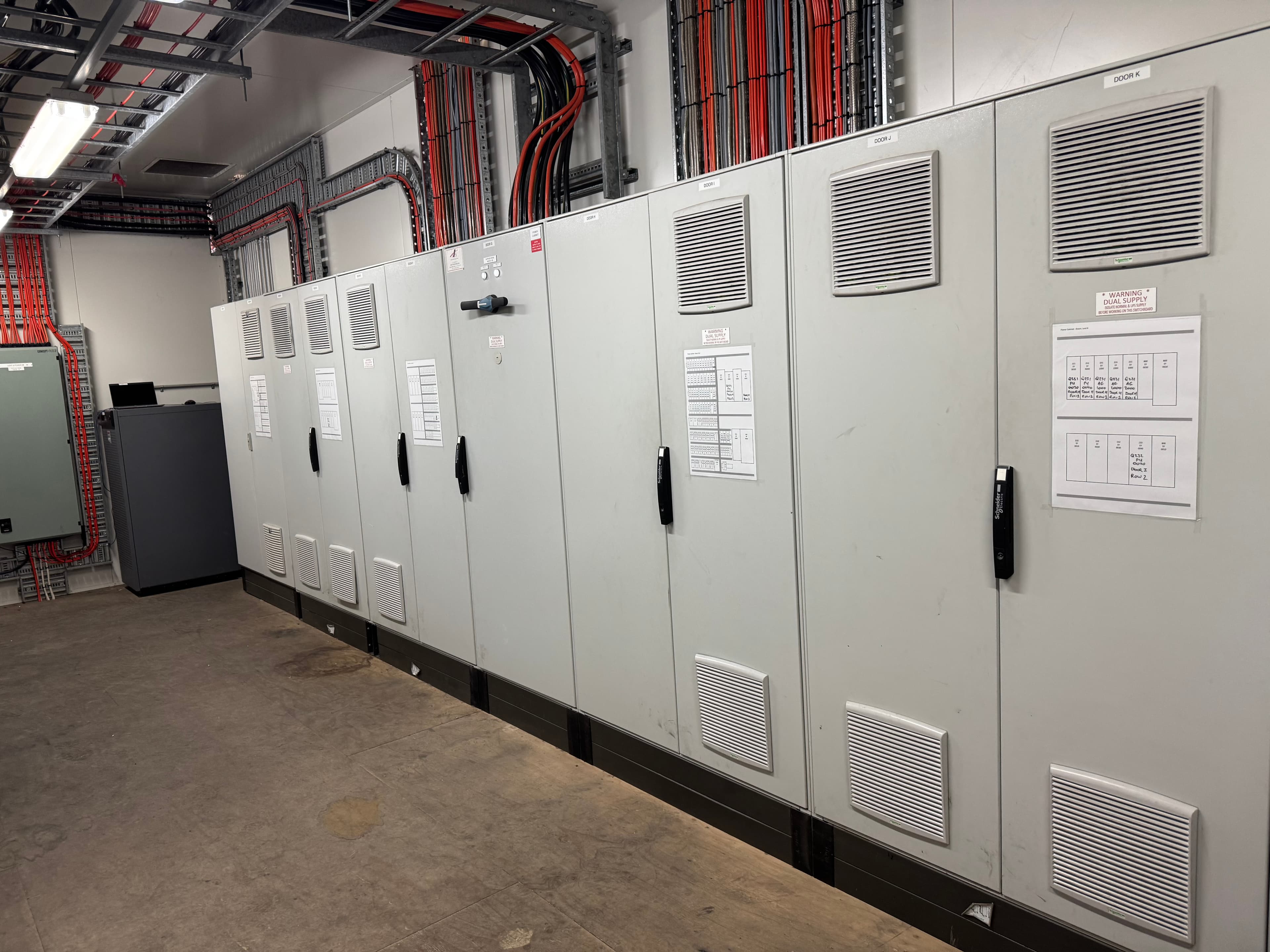
Metromotion Controls designs industrial switchboards and motor control centres (MCCs) to AS/NZS 61439 from Mount Waverley, Melbourne, for production sites across Australia. We engineer the design package and specification; fabrication is carried out by partner switchboard builders, and we stay involved through their build, FAT and site installation.
Metromotion Controls is a design house for industrial switchboards and MCCs, not a switchboard manufacturer. We set the ratings, form of separation, layout and specification to AS/NZS 61439, produce the drawing package partner builders fabricate from, then review shop drawings, witness FAT and support installation so the finished assembly matches the process, the drives and the control system.
Metromotion Controls does not manufacture switchboards or MCCs. Our role is the engineering: the single-line diagram, ratings, form of separation, general arrangement, schematics and the specification a builder prices and builds against. Fabrication is carried out by partner switchboard builders, who build to a design-verified assembly system under AS/NZS 61439 and carry out routine verification on each assembly. Keeping design and fabrication separate gives the asset owner an independent design package they can tender, and a designer who checks the builder's shop drawings and test records against it rather than marking their own work.
Most switchboard problems start in a thin specification. We define the rated current of the assembly and of each circuit, the rated short-time withstand current taken from the site fault level, the rated diversity factor, the form of separation, the IP and IK ratings, the service conditions and the earthing arrangement before layout starts. Those values decide busbar sizing, enclosure construction and heat dissipation, and they give the builder a clear basis to show design verification against. Where the site has its own switchboard standard, we design to it and flag any conflicts with AS/NZS 61439 and AS/NZS 3000 before they reach the workshop.
A motor control centre is designed around how the plant runs. We work from the motor list and the P&ID to decide which loads need direct-on-line starters, soft starters or variable speed drives, and which functional units must be isolated for maintenance while the rest of the MCC stays in service. That choice drives the form of separation and whether withdrawable or fixed units make sense. Drive heat, harmonics, EMC segregation, bypass arrangements and the network that carries drive status to the PLC are all settled in design, so the MCC suits the control philosophy rather than being retrofitted to it during commissioning.
For main switchboards and distribution boards, the design starts with the supply: the network fault level, the incoming protection and how discrimination will work down through the sub-boards to the largest motor circuits. We set out metering and power monitoring points so energy use can be reported by area, allow spare ways and busbar capacity for the next production line, and document how the board will be isolated for maintenance. On the Chobani yoghurt plant this covered a site power upgrade with new mains design, building services and process power distribution.
The design package is issued so more than one switchboard builder can price the same scope: specification, single-line diagram, general arrangement, schematics, cable and terminal schedules and a bill of materials with approved alternatives. After award we review the builder's shop drawings and design verification evidence against the specification, answer technical queries and manage changes so the drawings stay aligned with the control panels, drives and PLC I/O they connect to. That is the same discipline we apply to control panel engineering, extended to the power side of the plant.
Before the assembly leaves the builder's workshop we witness factory acceptance testing against the design: routine verification records, functional checks of control and interlock circuits, network checks on intelligent MCCs and labelling against the drawings. On site we support installation, termination checks, energisation planning and commissioning with the electrical contractor. Handover includes as-built drawings, ratings and verification records, the final bill of materials and maintenance notes, which keeps later automation upgrades and fault-finding safe and controlled.
No. Metromotion Controls designs switchboards and MCCs; partner switchboard builders fabricate them. We produce the specification and drawing package, review the builder's shop drawings and verification evidence, witness FAT and support installation, so you get an independent design and an experienced builder rather than one party checking its own work.
Yes. We can design to a builder you already use, or issue a tender-ready package so several builders can price the same scope. Either way the design states the ratings and construction the builder must verify under AS/NZS 61439.
AS/NZS 61439 covers low-voltage switchgear and controlgear assemblies, with Part 1 for general rules and Part 2 for power switchgear and controlgear assemblies such as MCCs and main switchboards. AS/NZS 3000 governs the installation the assembly connects into. Site standards, network operator requirements and functional safety obligations are added where they apply.
A motor and load list, the P&ID or process description, the supply details and prospective fault level, the site electrical and switchboard standards, and any space, access or environmental constraints. Where some of this is missing, the first design stage establishes it.
When one functional unit needs to be isolated and worked on while neighbouring circuits keep running, which is common on continuous process lines. A machine MCC that is only serviced during a full shutdown often suits a lower form. The choice follows the operating and maintenance model, and it is settled before layout because it changes the enclosure size and cost.
Yes. Drive selection, heat load, harmonics, EMC segregation, bypass arrangements and network integration are part of the MCC design. On the La Casa del Formaggio cheese plant, the MCC design covered 3 Motor Control Centres and 21 PowerFlex525 VSDs.
Electrical design, control cabinet upgrades and panel-build support for industrial projects.
Commissioning engineers, acceptance testing, loop checks, startup support and control system readiness audits across Australia.
Functional safety assessment, SIL determination, safety instrumented functions and machine safety to IEC 61508, IEC 61511 and ISO 13849.
Process control for chemical, process and utility plants: loops, sequences, batch, boilers, steam and utilities.
Controls for yoghurt and cheese plants, milk receival, pasteurisation, CIP and production reporting.
Greenfield dairy facility automation with process controls and commissioning support.
Large capital project delivery across process automation, electrical engineering and commissioning.
A designer's guide to responsibilities, ratings, design and routine verification and FAT evidence under AS/NZS 61439.
AS/NZS 61439 and AS/NZS 3000 compliance, form of separation, MCC design, short-circuit rating, thermal management, FAT and handover records.
When a variable speed drive saves energy, how to build the case and how to replace an ageing drive.
La Casa del Formaggio needed a greenfield cheese manufacturing facility to support production growth. Metromotion Controls delivered the electrical and automation scope from design through commissioning, building out 3 Motor Control Centres and 21 PowerFlex525 VSDs for the plant drives and tying the process together through 30 PID loops and 16,237 Ignition tags. The scope covered MCC design, Ignition visibility, process automation, CIP controls, training and handover.
Chobani needed a controls partner to help establish its Australian manufacturing operation with new production lines and site infrastructure, and the relationship has had to keep adding and optimising lines without disturbing production already running on site. Metromotion Controls supported the initial setup and has continued to add, optimise and support production lines over the years, bringing process, packaging and site services onto common control and data interfaces so each addition extends one operating environment rather than a separate island. The scope spans plant services including boilers, refrigeration, trade waste, power monitoring and water usage monitoring, plus OEE, site data analytics and contextualised production data from lab equipment and other external sources.
Electrical control panel engineering for Melbourne production sites: build-ready drawings, ratings, panel-builder coordination, FAT and as-built handover.
Functional safety, machine safety automation and safety PLC programming to IEC 61511, IEC 62061, ISO 13849 and AS 4024.
FAT, SAT, loop checks, startup support and defect closeout before production handover.
Industrial automation engineering for Australian manufacturers, covering PLC, SCADA, control panels, commissioning and support.
Speak directly with an engineer about scope, timing and technical constraints.